





Table of Contents
On October 8, 2007, India and Australia produced one of those ODI finishes that seemed to belong to Australia until the very last few minutes. Chasing 292 in Chandigarh, Australia had reached 268/5 in the 46th over and looked firmly on course for another victory over India. Matthew Hayden had made 92, Andrew Symonds was still dangerous at the other end, and Australia needed only 24 runs from their final 20 balls with five wickets in hand. Then, almost without warning, the game turned completely.
India had started the match by posting 291/4 after winning the toss. Sachin Tendulkar made a patient 79 from 119 balls, Sourav Ganguly contributed 41, and Yuvraj Singh scored 39. But the late charge came from India's captain, MS Dhoni, who finished unbeaten on 50 from just 35 balls, while Robin Uthappa smashed 30 from 18. Their acceleration gave India a total that initially looked competitive, but Australia's reply suggested it might not be enough.
Hayden and Symonds Put Australia in Control
Australia's chase was built around two powerful innings. Matthew Hayden attacked his way to 92 from 92 balls, hitting 11 fours and two sixes, while Andrew Symonds kept the pressure on with 75 from 84 balls. Ricky Ponting added 29, and Australia moved steadily towards the target without ever looking too far behind the required rate.
By the 46th over, Australia were 268/5. They needed only 24 runs from 20 deliveries, and with five wickets still available, the visitors appeared to have the match under control. India's bowlers had spent most of the afternoon trying to find a way back into the game, but Australia had successfully absorbed almost everything thrown at them.
Then came the collapse that changed the match.
Two Wickets Changed Everything
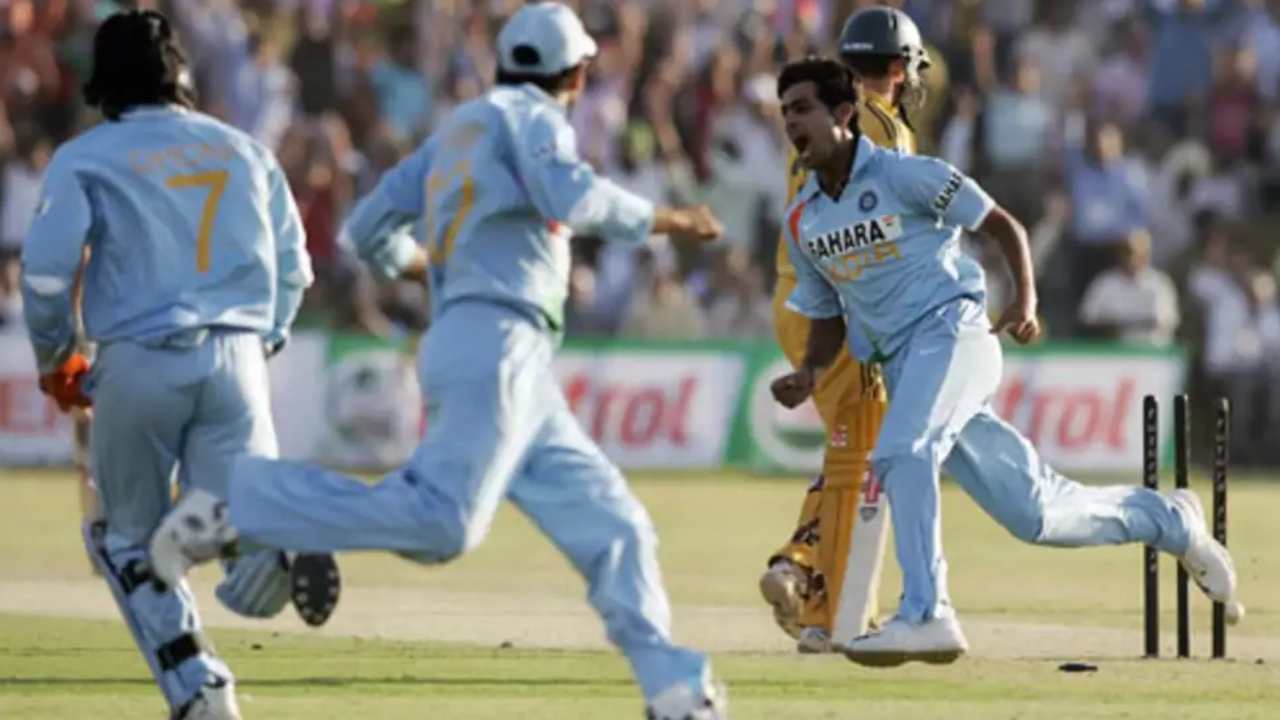
India struck twice in quick succession. Andrew Symonds, who had been keeping Australia within touching distance of victory, was dismissed by RP Singh for 75. Brad Hodge then fell to a stumping off Harbhajan Singh for 17.
Suddenly, the certainty around Australia's chase disappeared.
The visitors went from a position of 268/5 with the game almost under control to having their lower order exposed. India had found the opening they needed, and the pressure began to shift dramatically towards Australia. Contemporary reports described the two wickets in two balls as the moment that completely changed the complexion of the match.
Australia now needed 22 runs from the final two overs and had only three wickets remaining.
India Give Away Almost Nothing
Murali Kartik bowled the 49th over and conceded just two runs while also creating enormous pressure on the Australian batsmen. Australia entered the final over needing 9 runs to win.
That meant India were six legal deliveries away from pulling off a victory that had looked unlikely only a few overs earlier.
RP Singh was given the responsibility of bowling the final over. James Hopes was at the crease with Brett Lee, and Australia still had a mathematical chance of stealing the match.
But India held their nerve.
Australia managed only seven runs from the final over. When the last ball was completed, the scoreboard read 283/7 after 50 overs.
India had won by eight runs.
From 268/5 to 283/7
The final figures make the finish look deceptively straightforward.
India scored 291/4.
Australia scored 283/7.
The margin was eight runs.
But Australia had been 268/5 in the 46th over and were only 24 runs away from victory with five wickets available. From that point, India conceded just 15 runs while taking two crucial wickets, and Australia's chase eventually stalled seven runs short of the target.
James Hopes remained unbeaten on 23 from 20 balls, while Brett Lee finished unbeaten on 5 from nine. Brad Hogg was run out for a first-ball duck, leaving Australia unable to produce the final push they needed.
Dhoni's First ODI Win as Captain
The victory was also personally significant for MS Dhoni. He had taken over as India's ODI captain, but this was only his fourth match in the role, and India finally secured their first win under his captaincy.
Dhoni was named Player of the Match after his unbeaten 50 and his contribution behind the stumps. His innings had been particularly important because India had needed a strong finish after Tendulkar, Ganguly and Yuvraj had provided the foundation.
The victory also ended Australia's extraordinary run against India in limited-overs cricket. Australia had won their previous 11 ODIs against India, stretching back to January 2006, and had won 13 of their previous 14 limited-overs matches overall. India's eight-run victory finally stopped that run.
Australia Had the Match in Their Hands
What makes this game worth remembering is not simply that India won by eight runs. It is how close Australia were to winning it.
Hayden had done the hard work with 92. Symonds had scored 75. Australia had reached 268/5 and needed only 24 from 20 balls. At that point, the match appeared to be moving towards another Australian victory.
Instead, two wickets changed everything.
Kartik and Harbhajan Singh squeezed the scoring, RP Singh held his nerve at the death, and Australia's lower order could not finish the job. Australia needed nine from the last six balls but managed only seven.
For India, it was a victory built on refusing to let the match slip away when it appeared to be gone.
A Famous Chandigarh Finish
The result kept the seven-match series alive, although Australia still led 2-1 after the first match had been abandoned because of rain. India had also finally beaten Australia in an ODI after a long run of defeats, giving the home side and the Chandigarh crowd a victory that felt bigger than the eight-run margin suggested.
It was a match containing several of the biggest names of that era — Tendulkar, Ganguly, Dhoni, Yuvraj, Hayden, Ponting and Symonds — but the defining moment came right at the end. Australia had spent most of the chase looking like the better side, yet India produced their best cricket when the result was almost within Australia's grasp.
On This Day: October 8, 2007
Australia needed 24 runs from 20 balls with five wickets in hand. Then India struck twice.
Australia needed 22 from the final two overs. They scored only 13.
Australia needed 9 from the final over. They scored just 7.
The final score was India 291/4, Australia 283/7.
Eight runs separated the two teams, but the real story was the remarkable turnaround from Australia's position of 268/5. India had been staring at another defeat against Australia, only to find a way back into the game during the final four overs.
And at the centre of it all was a young MS Dhoni, captaining India to his first ODI victory in the role and collecting the Player of the Match award.
Australia needed nine. India needed six balls. The six balls belonged to India.